 Junior IAS Academy
Study skills
How to Study and Remember What You Learn: A Research-Informed Guide for Classes 6–10

“I understood it yesterday. Why can’t I explain it today?”
Many students recognise this feeling. The page looked familiar, the example made sense, and the chapter seemed finished. Then a question appeared without the textbook beside it, and the answer was harder to find.
That moment is useful information. It tells us that reading a lesson and being able to use it independently are different tasks. A good study routine makes room for both.
This guide from Junior IAS Academy is for students in Classes 6–10 and the parents and teachers who support them. It explains a few well-researched learning ideas and turns them into practical activities for science, mathematics, social science and reading. The sample routines are suggestions to adapt, not a prescription for every child.
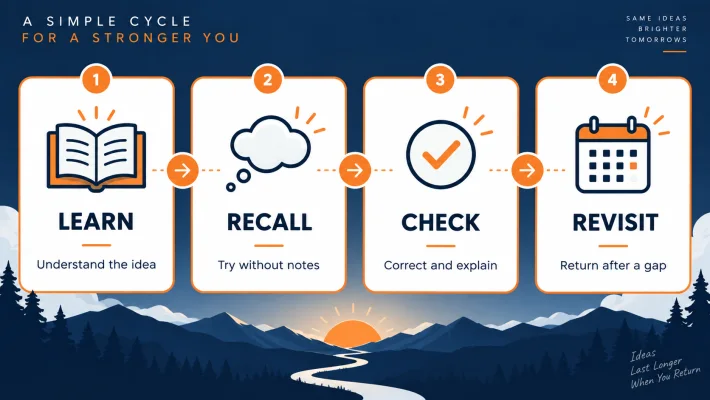
The central idea: Learn with understanding, try to recall without looking, check what needs correcting, and return to the topic after a gap.

What does research actually tell us?
Retrieval practice means trying to bring previously learned information to mind. It might involve explaining a concept, sketching a diagram or answering a question before opening the notes. It is a learning activity, not necessarily a graded test.
A 2021 systematic review by Pooja Agarwal, Ludmila Nunes and Janell Blunt examined 50 classroom experiments involving 5,374 learners. It reported benefits across different educational settings, but also noted that only 6% of the experiments came from countries outside the commonly studied Western, educated, industrialised, rich and democratic contexts. That is a reason to apply the evidence thoughtfully, rather than promise identical results in every Indian classroom. Read the research abstract.
Research also needs a fair comparison. A separate classroom review found the advantage of retrieval was less consistent when compared with some other active learning activities than when compared with simply restudying or doing nothing. The practical message is to combine recall with explanation, instruction and meaningful practice—not turn every lesson into a quiz. Moreira and colleagues, 2019.
Begin with a question you can answer
“Study geography” is difficult to act on. “Explain how a river carries and deposits material” gives the session a purpose. Before opening the book, write one question that matches what your teacher expects you to understand.
Read a manageable section, examine the diagram and clarify unfamiliar words. If the explanation still does not make sense, ask for help. Trying to recall material that has never been understood is unlikely to solve the underlying difficulty.
Here are some starting questions you can adapt to your current syllabus:
- Science: What changes during evaporation, and what stays the same?
- Mathematics: Why is each step in this equation valid?
- Social science: What problem was this institution created to address?
- English: Which detail in the passage supports my interpretation?
The question should be small enough to attempt and important enough to discuss. A page count alone does not tell you what you have learned.
Close the book and make your thinking visible
After studying, put the material aside briefly. Write what you remember, answer your starting question aloud, or draw the process from memory. Use ordinary language first; then add the precise subject vocabulary.
For a science process, a rough diagram with explained arrows is more useful than an attractive drawing whose connections you cannot describe. For history, try a short sequence that connects an event, its causes and its consequences. For vocabulary, use the word in a sentence of your own.
Keep this attempt private or low-pressure. The aim is to find the parts that need attention. You do not need a score for every practice activity.
If nothing comes to mind, make the task smaller. Look at one heading, use a teacher-provided cue, or return to an explanation. A blank page is a signal to adjust support, not a reason to label yourself a poor learner.
Checking is a separate step
Open the textbook or a reliable teacher-provided answer after your attempt. Compare carefully. Mark what was accurate, what was missing and what was misunderstood.
Do more than copy a correct sentence over an incorrect one. Write a short explanation of the correction: “I described the result, but I did not explain the cause,” or “I used the right formula but substituted the wrong quantity.” This makes the next practice attempt more purposeful.
The Australian Education Research Organisation recommends retrieval opportunities that include all students and the use of feedback to address gaps. Its guide also stresses selecting tasks appropriate to what students have learned. AERO spacing and retrieval practice guide.
For your own notebook, three headings are enough: My attempt / What needs changing / What I will try next. You can complete a useful entry in a few lines.
Return to important ideas after a gap
Spacing means revisiting learning across separate occasions. Instead of treating a completed chapter as permanently finished, bring selected ideas back into later sessions.
The US Institute of Education Sciences recommends spreading learning over time, using quizzes to revisit key content, and asking explanatory questions. These are teaching and study principles, not a claim that one fixed timetable suits everyone. IES practice guide.
For example, after studying a topic on Monday, you might attempt a few questions on Wednesday and explain the main idea again over the weekend. If you can answer comfortably, include a more demanding application next time. If the explanation has become confused, revisit the relevant section sooner.
Treat that timetable as an example. The right gap depends on the topic, your current understanding and when you need to use the knowledge. A guide by cognitive scientists Shana Carpenter and Pooja Agarwal explains why recall across spaced sessions, followed by checking, can support durable learning. Spaced retrieval guide.
Adapt the routine to the subject
In mathematics, explain the method as well as the answer. Start with a worked example from your teacher. Cover it and attempt a similar question. When checking, locate the first step where your reasoning differs. Later, try a question where you must decide which method to use, rather than being told in advance.
In science, connect words, diagrams and observations. After learning a process, draw a simple version from memory and explain what each arrow means. Then consider an everyday example. If the explanation changes between the diagram and your spoken answer, investigate that difference.
In social science, connect facts with relationships. Knowing a term is a starting point. Ask what it means, why it matters and how it connects to the topic. Make a small comparison between two ideas that are easy to confuse. Check the comparison against your textbook.
In reading, support your answer with the text. Read a short passage, summarise its main point, then reopen it to find the details that support your summary. Distinguish what the writer states from what you infer. An interesting opinion still needs a reason.
These are original classroom-style activities for this guide. They are not a substitute for your teacher’s subject-specific instructions or assessment criteria.
Learn to notice how you are learning
The word metacognition describes thinking about and managing your own learning. In practice, it can be as simple as deciding how to approach a task, noticing when the approach is not working, and reviewing what helped.
The Education Endowment Foundation advises teaching these strategies explicitly within real subject lessons. Students benefit from seeing teachers model how they plan, monitor and evaluate a task; simply telling children to “think harder” is not enough. EEF guidance.
Try a short reflection after a study session:
- What was I trying to understand?
- What could I explain without help?
- Where did I need a hint or an example?
- What is the next useful question?
Be specific. “I am bad at science” closes the conversation. “I can name the stages, but I cannot explain why this stage happens” gives you and your teacher a workable starting point.

A sample week: one topic, several kinds of thinking
Consider a fictional Class 8 student, Meera, working on a school lesson about local government. This example illustrates a routine; it is not an Academy student testimonial or a measured intervention.
Monday: Meera reads the assigned section and writes two questions about responsibilities and decision-making. She checks the meaning of unfamiliar terms with her teacher’s notes.
Wednesday: Without looking, she explains one responsibility in her own words. Her explanation confuses two levels of government. She checks the text and writes a corrected comparison.
Friday: She discusses a simple community issue with a classmate: a public space needs maintenance. They identify what they know, what they are assuming, and which details they would need to verify before assigning responsibility.
Sunday: She revisits the original questions and writes a short answer with an example. She notes one remaining doubt for class.
The useful outcome in this example is a clearer record of her thinking. No score increase is invented. She has moved from recognising a paragraph to explaining an idea, finding an error and applying a distinction.
How parents can help without taking over
Ask your child to show one idea they can now explain and one question they still have. Listen before correcting. If the answer is unclear, invite them to use the book to investigate it with you.
Useful prompts include: “What makes you think that?”, “Can you show me an example?” and “Which part should we ask the teacher about?” Avoid turning every conversation into a rapid-fire quiz or comparing the child with a sibling.
Agree on a manageable place and time for study. Keep space for play, interests and rest. If the routine repeatedly causes frustration, reduce the amount, adjust the format and speak with the teacher about suitable support. Some students may explain more clearly aloud, through a diagram or with a prompt before they are ready to write independently.
The adult’s role is to support growing independence, not produce perfect answers on the child’s behalf.
Frequently asked questions
Is rereading a waste of time?
No. Reading helps you encounter and clarify material. Add an attempt to explain or use it, followed by checking, so your routine also reveals what you can do independently.
Does retrieval practice mean memorising everything word for word?
No. Questions can require explanation, comparison and application. Some precise terms need accurate recall, but understanding also involves relationships and reasons.
How long should a student study each day?
There is no single duration established by this article. School demands, age, task difficulty and individual needs vary. Begin with a manageable task and review whether the time produced useful learning.
Can these habits help future competitive-exam preparation?
They can support knowledge-building and independent study. They do not guarantee selection or mean that a school child needs an adult exam timetable. At this stage, strong school understanding and curiosity are worthwhile goals in themselves.
Start with one lesson
Tonight, choose a small topic you have already been taught. Ask one question, explain the answer without looking, check it, and decide when to return. Keep the correction as carefully as the answer.
For students, families and educators in the Junior IAS Academy community, that is a practical starting point: make learning visible, discuss uncertainty openly, and build a routine that becomes more independent over time.
Research note: The linked sources explain the evidence behind the learning principles. The subject activities, sample schedule and fictional example are original illustrations, not tested claims about this Academy’s programme or results.
- JUST AN OPPORTUNITY TO UNDERSTAND OUR OWN CITIZENSHIP LAWS! 🇮🇳
- How Students Can Disagree Without Arguing
- How to Read Charts and Percentages: A Data-Literacy Guide for School Students