 Junior IAS Academy
Communication
How Students Can Disagree Without Arguing
A strong opinion is only the beginning
One student thinks the class outing should visit a museum. Another wants a nature park. Both have reasons. Within a minute, however, the discussion becomes a contest over who can speak louder. The class has plenty of enthusiasm and very little progress.
Disagreement is an ordinary part of learning. Students will meet it in group projects, classroom discussions, friendships and family decisions. The useful skill is to explain a view clearly, understand another person's reasoning and keep the conversation workable when the answer is not obvious.
For parents and teachers supporting school students in Chennai and across Tamil Nadu, small everyday discussions offer a place to practise. The goal is not a child who agrees with everyone. It is a child who can think, listen, question and speak with respect.
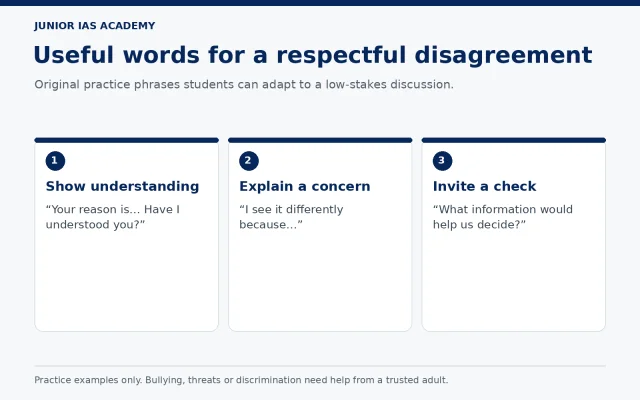
A useful sentence to practise: “I understand your reason. I see it differently because…”
Keep the idea separate from the person
“That plan may take too much time” addresses a proposal. “You always have bad ideas” attacks a person. The first gives the group something to examine. The second makes it harder for anyone to listen.
Ask students to name the exact point they disagree with. Is it the cost, the evidence, the timing or the expected result? A specific disagreement can become a useful question. A label about someone's intelligence or character usually closes the conversation.
Adults can model this distinction without making a speech. When a child proposes something impractical, explain the constraint and invite another approach. The child hears how a person can take an idea seriously while still deciding that it needs to change.
Explain the other view before answering it
Listening becomes easier to notice when it produces a brief, fair explanation. Ask a student to summarise the other person's reason and check whether the summary is accurate. This is a listening exercise, not a requirement to agree.
For example: “You prefer the museum because you think we can connect the visit to our history lesson. Have I understood you?” The other student can correct the summary before the discussion moves on.
UNICEF's communication guidance encourages active listening and checking understanding with children. In a school discussion, the same broad principle helps adults and students avoid answering a point that nobody actually made. Keep the practice brief so it feels like a conversation rather than a test.
Give the opinion a reason
A reason explains why a person holds a view. Evidence helps someone assess whether that reason is supported. Students need opportunities to distinguish both from simply repeating the opinion with more confidence.
Compare “The park is better because it is better” with “The park may suit our science topic because we are studying local plants.” The second sentence creates a question the group can investigate: does the proposed visit actually support that learning goal?
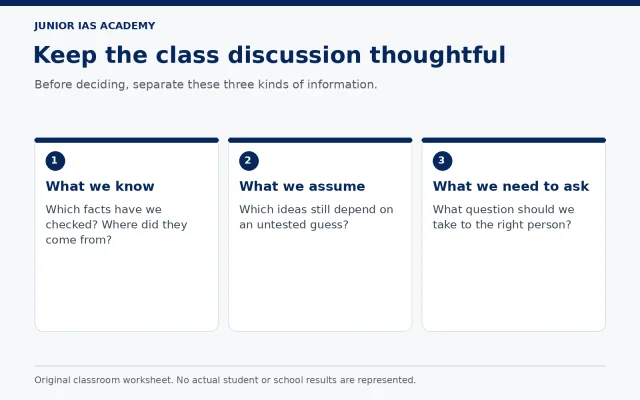
Encourage students to identify the source of a factual claim. A school notice, an official visitor-information page and a classmate's memory provide different kinds of support. If the fact has not been checked, a student can say so. Honest uncertainty is a useful part of reasoning.
Ask a question that opens the discussion
Some questions are invitations. Others are accusations wearing a question mark. “How would your plan fit within the available time?” invites an explanation. “Do you even understand the timetable?” puts the other person on the defensive.
Practise questions about the proposal: what information is missing, which difficulty matters most, and what would make the option more workable? Give the speaker time to answer before asking the next question.
A student does not have to produce a clever challenge every time. A simple request such as “Can you explain that example?” can move the discussion further than a dramatic objection prepared while the other person was speaking.
Notice that there may be more than two viewpoints
A debate can become stuck when students assume the class has only two camps. A third student may care about accessibility. Another may be worried about travel time. Someone else may want to understand how the outing connects to the current lesson.
Harvard Project Zero's work on perspective-taking highlights that people can have different connections to the same topic. Students can explore that general idea by asking whose experience or concern the discussion has not yet considered.
Do not ask a student to speak for an entire community or guess another person's private circumstances. Invite people to describe their own relevant needs, and let the responsible adults handle sensitive information appropriately.
Use a small fictional example
Return to the museum and nature-park discussion. This is an invented classroom scenario, not a reported Junior IAS Academy session. The teacher first asks the group to agree on the decision it needs to make and the constraints it must respect.
The students identify learning relevance, available time, cost and the needs of the group. They separate confirmed information from assumptions. The museum supporter acknowledges that the park could support a science discussion. The park supporter recognises the connection between the museum and the history lesson.
They still disagree. That is acceptable. Each student now understands more about the other proposal and can explain the remaining difference. The teacher can guide a decision using the agreed criteria rather than rewarding the loudest speaker.
The valuable learning is in the discussion as well as the choice: students practise explaining, checking, revising and accepting that a group decision may differ from their first preference.
Make changing your mind an ordinary option
Children can feel that revising a view means losing. Adults can help by showing what a thoughtful change sounds like: “I had not considered that travel time. With that information, I would adjust my plan.”
Invite students to name what could change their view. A different fact, a clearer explanation or a constraint they had missed may matter. This question helps distinguish a conclusion based on reasons from a position that must be defended regardless of the evidence.
Changing one's mind is not always required. A student may understand the other view and still reasonably disagree. The important habit is to give reasons that respond to the discussion instead of simply repeating the opening sentence.
Give quiet students a way in
A fast discussion can reward speed rather than thought. Offer a short pause to write a reason or a question before speaking. A student who needs more time can then enter with something prepared.
Small pairs may feel easier than a whole-class debate. Where appropriate, students can begin in a language they use comfortably and then work on expressing the same reasoning in the classroom language. Language practice and the quality of an idea deserve separate attention.
A facilitator can also check who has not had a turn. Avoid making a quiet student perform unexpectedly in front of the group. Provide a clear invitation and a manageable way to contribute.
Pause when the conversation becomes too heated
If people are interrupting, mocking or raising their voices, the next step may be a pause rather than another argument. Agree a simple way to stop, settle and return to the specific issue when the group is ready.
Adults should not describe bullying, threats or discriminatory remarks as an ordinary debate that children must solve alone. A student should be able to seek help from a trusted teacher or caregiver. Respectful discussion requires an environment where people can participate safely.
UNICEF India's guidance for caregivers of adolescents encourages open communication and handling disagreements without aggression. Adults can demonstrate this approach through their own tone, turn-taking and willingness to repair an unfair remark.
A ten-minute practice for home or a learning group
Choose a low-stakes question with more than one reasonable answer, such as how to organise a small reading corner. Give each person a minute to prepare one preference and two reasons. Then invite them to explain the other view before presenting their response.
Ask one open question each. Finish by identifying an agreed point, a remaining difference and any fact that needs checking. Keep the outcome small enough to complete without an extended competition over who won.
Afterwards, reflect on the process. Was the other view described fairly? Did anyone ask a useful question? Did new information change the discussion? These observations give students something practical to try next time.
What parents can look for in a programme
When exploring a school-student learning programme, ask how mentors support discussion. Are students encouraged to explain their reasons? How are quieter participants included? What happens when a confident answer is unsupported or a disagreement becomes personal?
Junior IAS Academy is a place for parents to discuss the current programmes available for their children. Ask about the actual activities, feedback and age suitability. Reasoning and communication should be visible in the learning experience, with room for students to ask questions and improve over time.
Sources and further reading
- JUST AN OPPORTUNITY TO UNDERSTAND OUR OWN CITIZENSHIP LAWS! 🇮🇳
- How to Read Charts and Percentages: A Data-Literacy Guide for School Students
- Map Reading for Students: Directions, Scale and Coordinates Explained with Simple Activities