 Junior IAS Academy
Communication
Public Speaking for School Students: A Practical Guide to Clear Ideas, Listening and Respectful Debate
Students become clearer speakers by practising small, manageable conversations: explain one idea, support it with a reason, listen to another person and respond respectfully. For learners in Classes 6–10, a useful starting point is a short talk to someone they trust, followed by one specific suggestion for the next attempt.
Public speaking includes asking a question in class, explaining a science model, discussing a school issue and presenting a group’s decision. A student does not need a stage, a competition or perfect English to begin. This guide offers a practical way for students, parents and teachers to build those everyday skills without turning childhood into a performance test.
What should school students practise first?
Start with meaning. Can the listener understand the main point? Can the speaker explain why it matters? Can both people stay interested in the conversation? Volume, pace and posture can be refined gradually, after the student has something useful to say.
India’s National Education Policy 2020 includes communication, discussion and critical thinking among its educational priorities. It also recognises the importance of multilingual learning. These are good reasons to make speaking part of ordinary learning rather than reserve it for confident volunteers.
Research needs careful interpretation. The Education Endowment Foundation’s oral-language review supports purposeful speaking and listening, particularly when connected to the curriculum. Much of its evidence concerns literacy, with more studies in younger age groups. It does not establish that a particular public-speaking class will deliver a guaranteed improvement for every secondary-school student.
A sensible practice goal is therefore observable and personal: explain a point more clearly than last time, ask a better follow-up question or speak once in a group where the student previously stayed silent.
Build a one-minute talk around four simple moves
A short structure gives students somewhere to start. Use a topic they already understand, such as keeping classroom books organised, choosing a class activity or explaining an interesting object.
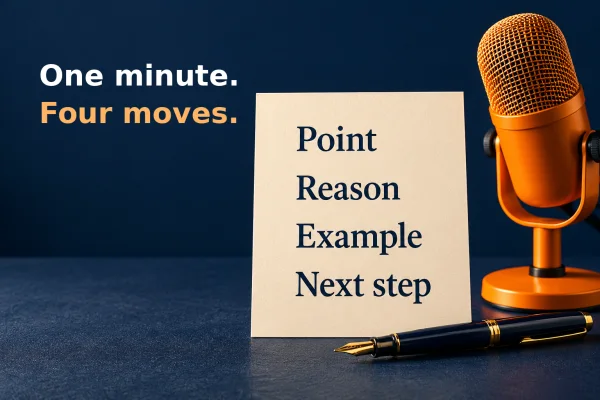
- Point: What is the one idea you want the listener to remember?
- Reason: Why do you think that idea is useful or reasonable?
- Example: What observation, experience or clearly identified evidence makes it concrete?
- Next step: What would you suggest, ask or conclude?
For example: “Our classroom should have a return tray for borrowed books. It would give everyone one place to look. Yesterday, I found a library book under a pile of worksheets. We could try the tray for a week and see whether it helps.” This is a fictional practice speech, not a report about a particular school.
The example is deliberately modest. One misplaced book does not prove that every classroom has the same problem. A good speaker describes what they actually know and keeps the conclusion proportionate.
Write four keywords on a small card rather than memorising a full script. The student can glance at “tray, easier, book, trial” and express the idea naturally. If they lose their place, pausing and returning to the next keyword is a useful skill in itself.
Choose topics with room for a real discussion
A good beginner topic is familiar, specific and safe. “How could we make the classroom reading corner easier to use?” is easier to explore than “How should education change?” Narrow questions encourage students to offer workable ideas.
For Classes 6–7
- Explain how to play a favourite game fairly
- Recommend a book to someone with different interests
- Describe one improvement to a shared classroom space
- Teach a partner a simple process in the correct order
For Classes 8–10
- Compare two ways of organising a school event
- Discuss how a class could reduce wasted materials
- Explain a local civic issue using an age-appropriate source
- Consider the advantages and difficulties of a proposed school rule
These are suggestions, not age tests. A younger student may enjoy complex discussion; an older learner may need a simpler starting point. Avoid making classmates debate whether another person deserves dignity, inclusion or safety. No student should have to disclose a painful personal experience to make a speech interesting.
Listening is a skill you can practise separately
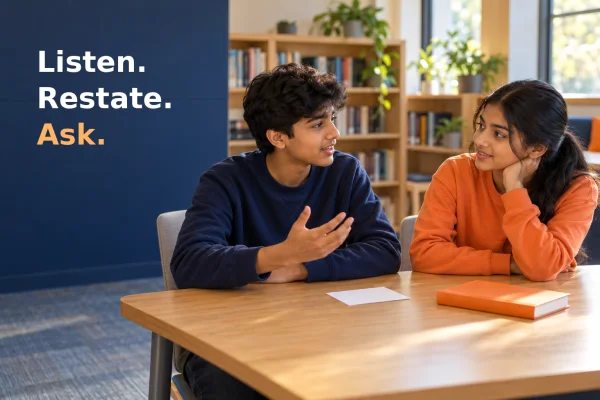
Students sometimes spend another person’s speaking time preparing their own reply. A small change helps: before responding, restate the other person’s main point and ask whether you understood it correctly.
Try a partner exercise. One learner explains a view for a short turn. The listener then says, “Your main reason is…” The speaker confirms or corrects the summary. Only then does the listener ask a question or add a different view. Swap roles afterwards.
Useful follow-up questions include:
- What makes that example important?
- Would the idea work for someone in a different situation?
- What would we need to know before deciding?
- Is there a smaller version we could try first?
The aim is to understand the idea accurately before evaluating it. Teachers can praise a careful summary just as visibly as an impressive speech, so that students notice listening is valued.
Disagree with a reason and leave room to change your mind
Respectful debate works best when the group agrees on a few rules before starting: one speaker at a time, no personal comments, fair speaking opportunities and a clear way to ask questions. A chairperson can keep the discussion on the proposal.
The UK Parliament’s secondary debating resource offers examples of structured classroom activities, planning and moderation. Its institutional setting is British; teachers in India should adapt activities to their own curriculum and classroom. The useful transferable idea is to make the discussion’s structure explicit.
Students can practise phrases such as “I see the benefit, but I’m concerned about…” or “That example changes part of my view.” These sentence starters help them move beyond agreement, disagreement and interruption.
Ask learners to describe one possible disadvantage of their own proposal. If they suggest a longer lunch break, what happens to the rest of the timetable? If they suggest more plants, who will water them during holidays? Considering a difficulty makes the proposal more thoughtful.
A discussion may end with a revised idea, an unanswered question or two reasonable options. Adults need not force a winner when the learning goal is understanding.
A hypothetical classroom example: planning a reading corner
Imagine a Class 8 group discussing a reading corner. This is an illustrative scenario, not a Junior IAS Academy student outcome or testimonial.
One learner wants new books. Another suggests rearranging the existing shelves. A third notices that some students cannot find books they enjoy. Initially, the group is arguing about solutions before agreeing on the problem.
The teacher asks each speaker to state their concern in one sentence. The students then separate three questions: Are enough books available? Can people find them? Do the choices match different interests?
Instead of voting immediately for the loudest proposal, they decide to inspect the shelves and invite voluntary suggestions. Each learner takes a different role: speaker, listener, note-taker or discussion chair. The group can revisit its proposal when it has more information.
The learning lies in the process: defining a question, explaining a reason, summarising another view and recognising what remains unknown. There is no invented claim about marks, confidence scores or future examination success.
Help a hesitant speaker choose the next manageable step
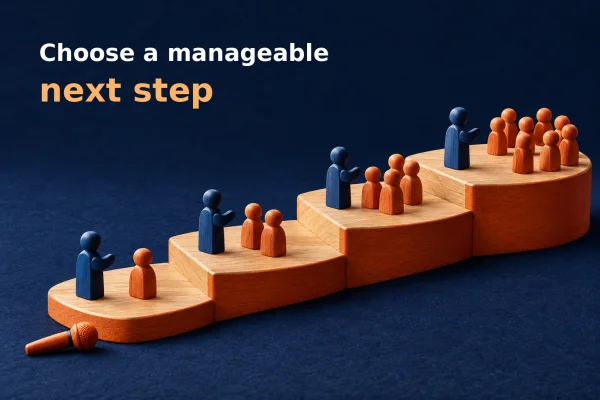
Some students are comfortable speaking to one friend and uncomfortable addressing the whole class. Plan a progression with them: a trusted adult, a partner, a small group, then a larger audience when appropriate.
Offer choices within the activity. A learner might begin by introducing an object, reading their own short paragraph, co-presenting with a partner or asking one prepared question. Give preparation time and explain the format in advance.
Avoid surprise performances, public comparisons and demands to “stop being shy.” If a student becomes distressed, reduce the pressure and talk privately about what support would help. Persistent communication difficulties or significant anxiety may call for advice from the school’s appropriate support staff or a qualified professional.
Students with disabilities or communication differences may use notes, assistive communication, an alternative format or extra processing time. Participation should be designed around access, not one ideal way of standing, looking or speaking.
Keep language practice separate from judging ideas
A student may explain an excellent idea in Tamil, Hindi or another home language and still be developing the vocabulary to present it in English. Let them first work out the meaning in a language they know well, then build the words needed for the intended audience.
For bilingual practice, ask for a short explanation in the familiar language, identify three important terms together and rehearse a brief version in the target language. Translation need not be word for word if the meaning remains accurate.
Correcting every grammar slip during a first attempt can interrupt the student’s thinking. Agree on the purpose of the exercise: explaining a concept, practising a particular phrase or preparing a formal presentation. Feedback can then match that purpose.
Use a light weekly routine rather than daily pressure
A short practice session can fit around ordinary schoolwork. The following sequence is a flexible example, not a scientifically validated training schedule.
- Choose: Pick one familiar question together
- Plan: Write a point, reason, example and next step
- Speak: Try the talk with a trusted listener
- Listen: Summarise the listener’s question before answering
- Reflect: Name one useful improvement for next time
Stop while the exercise still feels manageable. Families do not need to record or post the performance. If recording would help the learner, agree on it first, keep it private and follow school and family privacy expectations.
Choose feedback that describes something the student can change: “I understood your example; pause before the last sentence.” Avoid vague labels such as “born leader” or “weak speaker,” which say little about what to practise next.
Frequently asked questions
Does public speaking require fluent English?
No. Explaining ideas and listening can be practised in any language the learner uses. English presentation practice can be added when it serves the school task or the student’s goals.
Should students memorise speeches?
Memorisation may suit a particular performance, but everyday communication also needs flexibility. For practice, a short outline usually leaves more room to respond to questions and explain ideas in the student’s own words.
How can parents help without taking over?
Ask one genuine question, listen to the answer and offer one specific suggestion. Let the student choose their examples. Rewriting the entire speech may produce smoother wording while leaving them with less ownership.
Is debating useful only for competitive students?
No. A small discussion about a shared decision lets learners practise reasons, turn-taking and listening without a contest. Rotate roles so that students can contribute in more than one way.
How should progress be noticed?
Compare the learner with their earlier attempts. Look for a clearer main point, a more relevant example, a thoughtful question or greater willingness to participate. Progress can be uneven and need not become another public score.
Start with one worthwhile conversation
For school learners, the immediate value of speaking practice is being able to explain, ask, listen and take part. A useful first step today is simple: choose a familiar question, prepare four keywords and share the idea with a supportive listener.
Clear communication grows through many such opportunities, with room for different personalities, languages and learning needs.
Sources and further reading
- JUST AN OPPORTUNITY TO UNDERSTAND OUR OWN CITIZENSHIP LAWS! 🇮🇳
- How Students Can Disagree Without Arguing
- How to Read Charts and Percentages: A Data-Literacy Guide for School Students