 Junior IAS Academy
Critical thinking
Current Affairs for Students: How to Check Facts and Understand the News

A message appears in a class group: “All schools will be closed tomorrow.” It has a bold headline, an official-looking emblem and several forwards. Should you believe it?
Before deciding, you need more than the confidence of the person who shared it. Which schools? In which place? On what date? Who issued the information, and where can the original notice be found?
These questions are a useful starting point for current affairs. For students in Classes 6–10, understanding the news is about learning to investigate a claim, connect it with what you know and explain what the evidence supports.
The short answer: choose an age-appropriate story, identify its main claim, investigate who is behind it, check the supporting evidence and establish the date and context. Then write a short explanation that separates confirmed information from opinion and unanswered questions.
This Junior IAS Academy guide offers a practical approach for students, parents and teachers. The activities are original suggestions to adapt with adult guidance. They are not a promise of examination results or a requirement to follow every headline.
What should current affairs mean for a school student?
Current affairs includes developments in public life, science, the environment, culture, sport and other areas that affect people. A school student does not need to treat the news as an endless list of names and dates.
A better starting point is one understandable question. A report about a local water project might prompt: what problem is being addressed, and who is responsible for explaining the plan? A science story might prompt: what was observed, and what remains uncertain?
Choose stories that connect with the learner’s age, interests and school subjects. Teachers and parents can help select suitable material and explain unfamiliar background. Graphic or distressing content is not necessary for developing thoughtful reading habits.
For younger learners, begin with a short, adult-selected article and discuss it together. Older learners can take more responsibility for finding the original source and comparing accounts, while still asking for help when a topic becomes complex.

AI-generated educational illustration: students and a teacher examine a news report together. The people shown are not Academy testimonials.
Start by writing the claim in one sentence
A claim is something being asserted. Before checking it, make sure you know exactly what it says.
Imagine a fictional headline: “New library programme transforms reading across the city.” That sentence contains several possible claims. A programme may have started; it may operate in some libraries; the headline may also suggest an improvement in reading. Those are different questions to investigate.
Write the smallest clear statement first: “A new reading programme has started at these named libraries.” Then list the larger questions separately. What does “transforms” mean? Is there evidence about participation or learning? Does the report describe a plan, an early observation or a measured result?
This exercise keeps an exciting phrase from silently becoming a stronger conclusion than the article supports. It also gives the student a precise question to discuss with a teacher.
Investigate the source beyond its own page
A polished website can introduce an organisation, but its appearance does not establish its expertise or independence. Look beyond what an unfamiliar source says about itself.
The Digital Inquiry Group’s Civic Online Reasoning approach centres on investigating the people or organisations behind information, examining evidence and comparing what other sources report. One strategy is lateral reading: leaving the original page to learn about the source through other reliable information. Digital Inquiry Group: Civic Online Reasoning
With adult guidance, open a separate search and investigate the organisation’s role. Does it conduct the research, sell a related product, report on the subject or offer commentary? These roles can help explain a perspective, but none automatically proves a particular statement true or false.
For a school announcement, go to the school’s established communication channel. For a claim about a research finding, look for the original research or institution’s explanation. Ask whether the source is in a position to know the specific fact being checked.
What does the research suggest?
A 2023 study by Sarah McGrew and Joel Breakstone examined digital-literacy lessons integrated into ninth-grade biology and geography. Pre- and post-assessment data from 574 students showed improvement in evaluating online credibility. The lessons included explicit instruction and opportunities to practise evaluating sources. Read the study
This supports treating source evaluation as a skill to teach and practise. It does not establish that reading this article will produce the same outcome, or that the results apply identically to every Indian classroom. The study’s context and design matter when interpreting its findings.
For families, the practical takeaway is modest: show the checking process, let the student attempt it with support, and discuss the reasoning. Simply telling a child to “be careful online” leaves the method unexplained.
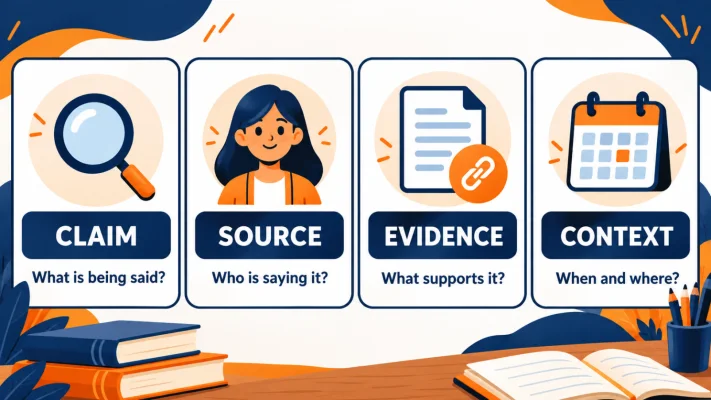
Four questions for a classroom discussion: what is claimed, who says it, what supports it, and when and where it applies.
Follow the evidence to what it actually shows
An article may link to a report, a notice, an interview or a dataset. Open the relevant source when it is suitable and accessible, and check whether it supports the statement you are investigating.
Consider a fictional report saying that a school collected 200 books for a library. A dated collection record might support the number collected. It would not, on its own, establish how many children read those books or whether their reading improved.
Ask students to draw two columns: “The evidence shows” and “The evidence does not yet show”. The purpose is not to dismiss useful information. It is to keep the conclusion close to what has actually been established.
When the source is too technical, ask a teacher to help identify the relevant section. Do not pretend to have verified a result merely because you found a document with a scientific title.
If the original evidence cannot be located, record that limit. “I have not verified this” is a useful statement of your current position.
Check the date, place and missing context
A real photograph or genuine notice can be misleading when attached to the wrong time or place. Begin with the publication date and, where relevant, the date of the event itself.
Return to the school-closure example. A notice might be authentic but apply to an earlier day, a particular district or only certain institutions. A screenshot may omit the section that defines its scope.
Ask the student to complete this sentence: “This information applies to ___, in ___, on ___.” If an important space remains blank, there is more to investigate before acting on or sharing the message.
Numbers need context too. “Participation doubled” is incomplete without the starting number, the period and what counts as participation. If a fictional club grows from five participants to ten, it has doubled; that does not mean it now includes most students in the school.
The arithmetic can be correct while an impression is exaggerated. Read both the number and the description around it.
Separate reporting, opinion and prediction
A single story may include several kinds of statements. A report that a meeting took place is different from a commentator’s view that the meeting was useful. A prediction about what will happen next is different again.
Try marking a short, teacher-selected passage with three labels: a factual statement that can be checked, an interpretation or opinion, and a prediction. Some sentences may require discussion before a label is appropriate.
An opinion can be thoughtful and well supported. The task is to recognise how the writer reached it and whether you find the reasoning persuasive. Disagreeing with an opinion does not automatically make the writer’s factual statements false.
Likewise, a prediction that later proves wrong should be assessed in light of how it was presented, what information was available and what uncertainty was acknowledged. Careful reading leaves room for these distinctions.
Repetition is not the same as independent confirmation
Three websites may repeat one press release. Several accounts may share the same screenshot. Counting those appearances does not tell you whether different people independently checked the claim.
When comparing reports, look for the origin of the information. Do they refer to the same announcement, or do they provide additional reporting or evidence? Explain the relationship in your notes instead of treating every repeated statement as a separate confirmation.
UNESCO’s media and information literacy resources encourage learners to examine false and misleading content and its effects. The broader aim is informed participation, not blanket distrust of all media. UNESCO: media and information literacy
A useful student habit is to ask, “What new information does this second source add?” Sometimes the answer is context. Sometimes it is a correction. Sometimes it adds nothing beyond repetition.
A strong current-affairs answer explains what is known, why it is credible and what remains uncertain.
Editorial takeaway from this Junior IAS Academy guide.
An illustrative classroom investigation
Consider a fictional Class 8 student, Kavya, who sees a post claiming that a public library will stop lending books. She is preparing a short classroom news discussion and initially writes, “The library is closing.”
With her teacher’s help, she finds the library’s original notice. In this invented example, lending is paused for a short stock-check period, while other services continue. She checks the dates and the library branch named in the notice.
Kavya revises her summary: “This branch has announced a temporary pause in lending during its stock check. The notice does not say that the library is permanently closing.” She includes the source, the relevant dates and one question about when normal lending resumes.
No examination score or programme result is claimed here. The example illustrates a change in reasoning: a broad interpretation becomes a narrower statement supported by the available evidence.
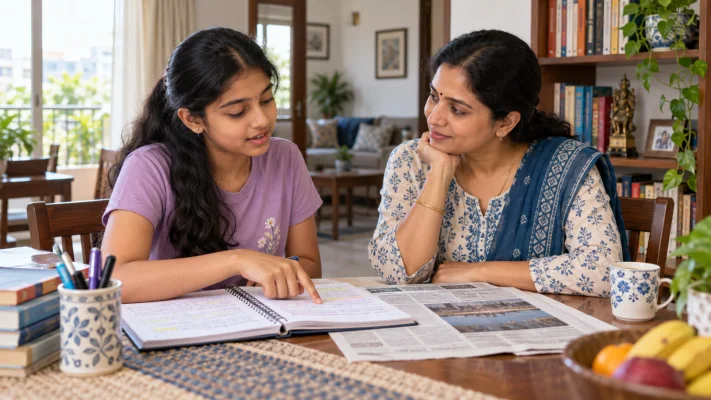
AI-generated illustration: a parent listens as a student explains her source and conclusion. The scene is fictional.
Build a useful current-affairs notebook
A notebook should help you explain a story, not become a collection of copied paragraphs. Try one page with these headings:
- My question: What am I trying to understand?
- The claim: What exactly is being asserted?
- Source and date: Where did I find it, and when does it apply?
- Evidence: What supports the claim?
- My explanation: What can I say in my own words?
- Still uncertain: What needs further checking?
- School connection: Which concept from class helps me understand it?
For a geography story, the connection might involve a map or a resource. For civics, it might involve an institution’s role. For mathematics, it might involve a percentage or a comparison. Avoid forcing every story into every subject.
Keep the page short enough to discuss. One well-explained development can offer more learning than a long list the student cannot interpret.
How parents and teachers can support the habit
Model uncertainty openly. Say, “I do not know yet; let us find the original information,” when that is your actual position. This shows that checking is part of responsible thinking rather than an admission of failure.
Ask the learner to explain the route taken: which source was checked first, what changed their view and which question remains open. Praise a well-supported correction instead of rewarding only a quick answer.
Use age-appropriate material and respect a child’s reaction to upsetting news. A student can learn source-checking with a library notice, a sports report or a science announcement. There is no need to seek disturbing content for practice.
Avoid asking children to confront strangers online or publish personal details as part of a checking exercise. An adult-guided discussion and private notes are enough. Follow the school’s digital-safety guidance and the rules of any tools being used.
Frequently asked questions
How can students start reading current affairs?
Begin with one suitable story selected with a teacher or parent. Identify the main claim, read the full account, clarify unfamiliar words and investigate the source before writing a short explanation.
Is memorising headlines enough?
A headline is a starting point. Understanding also requires the event’s context, the evidence behind the account and the ability to explain what it means without adding unsupported conclusions.
Should students believe an AI-generated news summary?
Treat it as a starting point for questions, not as independent proof. Open and check any cited sources. If a citation cannot be located or does not support the statement, leave the claim unverified. Follow school guidance on age-appropriate AI use.
What if reliable reports disagree?
Compare the date, scope, evidence and kind of statement being made. The reports may describe different stages or include different interpretations. Ask a teacher for help and explain the disagreement instead of forcing a confident answer.
Does this require an adult competitive-exam timetable?
No. For Classes 6–10, the activity can support curiosity, reading and civic understanding alongside normal school learning. This guide does not prescribe a study duration or promise future examination selection.
Start with one story and a better question
Choose a manageable news item this week. Write its main claim, trace the source and explain the evidence in your own words. End with one question that you would like to investigate further.
For students and families in the Junior IAS Academy community, thoughtful current-affairs reading can begin there: curiosity supported by evidence, respectful discussion and the confidence to say when something is not yet known.
Research note: The linked sources support the source-evaluation principles and research discussion. The classroom examples, notebook structure and family activities are original illustrations, not evaluated claims about Junior IAS Academy’s programme or students.
- JUST AN OPPORTUNITY TO UNDERSTAND OUR OWN CITIZENSHIP LAWS! 🇮🇳
- How Students Can Disagree Without Arguing
- How to Read Charts and Percentages: A Data-Literacy Guide for School Students